An error occurred. Details Hide
You have unsaved pages. Restore Cancel

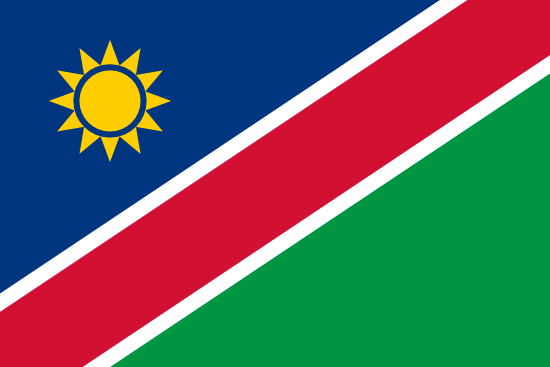
Namibia

  • President:Hage Geingob
  • Prime Minister:Saara Kuugongelwa-Amadhila
  • Capital city:Windhoek
  • Languages:Oshiwambo languages 48.9%, Nama/Damara 11.3%, Afrikaans 10.4% (common language of most of the population and about 60% of the white population), Otjiherero languages 8.6%, Kavango languages 8.5%, Caprivi languages 4.8%, English (official) 3.4%, other African languages 2.3%, other 1.7% note: Namibia has 13 recognized national languages, including 10 indigenous African languages and 3 Indo-European languages (2011 est.)
  • Government
  • National statistics office
  • Population, persons:2,533,794 (2017)
  • Area, sq km:823,290 (2017)
  • GDP per capita, US$:5,227 (2017)
  • GDP, billion current US$:13.2 (2017)
  • GINI index:61 (2009)
  • Ease of Doing Business rank:106 (2017)

All datasets: A C F K M N S
  • A
    • November 2012
      Source: World Bank
      Uploaded by: Knoema
      Accessed On: 18 November, 2012
      Select Dataset
      Africa Development Indicators (ADI) provides the most detailed collection of development data on Africa.
    • December 2011
      Source: African Development Bank Group
      Uploaded by: Balaji S
      Select Dataset
      Africa Millennium Development Goals
    • August 2015
      Source: African Development Bank Group
      Uploaded by: Balaji S
      Accessed On: 12 August, 2015
      Select Dataset
      African Development Bank, Bank Operations 2012
    • December 2011
      Source: African Development Bank Group
      Uploaded by: Balaji S
      Select Dataset
      African Development Bank, Food Security, December 2011
    • May 2017
      Source: African Economic Outlook
      Uploaded by: Balaji S
      Accessed On: 06 October, 2017
      Select Dataset
    • January 2018
      Source: Mo Ibrahim Foundation
      Uploaded by: Knoema
      Accessed On: 29 January, 2018
      Select Dataset
      Ibrahim Index of African Governance (IIAG) - is comprehensive statistical tool assessing African countries' performance in provision of public goods and services. Consisting of 133 variables derived from 32 independent sources IIAG measures governance performance across 4 pillars: Safety and Rule of Law, Participation and Human Rights, Sustainable Economic Opportunity and Human Development. All-embracing nature of the index makes it fairly the best instrument for setting long-term political, social and economical goals concerning the African region.
    • October 2013
      Source: Mo Ibrahim Foundation
      Uploaded by: Knoema
      Accessed On: 24 October, 2013
      Select Dataset
      Ibrahim Index of African Governance (IIAG) - is comprehensive statistical tool assessing African countries' performance in provision of public goods and services. Consisting of 133 variables derived from 32 independent sources IIAG measures governance performance across 4 pillars: Safety and Rule of Law, Participation and Human Rights, Sustainable Economic Opportunity and Human Development. All-embracing nature of the index makes it fairly the best instrument for setting long-term political, social and economical goals concerning the African region.
    • July 2013
      Source: African Development Bank Group
      Uploaded by: Knoema
      Select Dataset
      African Port Statistics, 2013
    • April 2016
      Source: African Development Bank Group
      Uploaded by: Knoema
      Accessed On: 16 May, 2016
      Select Dataset
      African Regional Energy Statistics, 2014
  • C
    • June 2016
      Source: African Development Bank Group
      Uploaded by: Knoema
      Accessed On: 20 July, 2016
      Select Dataset
      This Dataset describes the list of common indicators from census datasets of african countries.
    • September 2017
      Source: Knoema
      Uploaded by: Knoema
      Accessed On: 03 October, 2017
      Select Dataset
      Collect the cost of Consulting Services, diagnostics services and clinical procedures. If you are residing in Major cities/towns where you have both Public and Private Healthcare services, you can join this project and earn money.
  • F
    • September 2017
      Source: Knoema
      Uploaded by: Balaji S
      Accessed On: 11 September, 2017
      Select Dataset
      Collect food prices data in your country and earn up to $120 every month.We are looking for data collectors who will go to the specific markets weekly, collect data on food prices for about 25 items and submit them into our system.
    • July 2015
      Source: African Development Bank Group
      Uploaded by: Knoema
      Accessed On: 06 August, 2015
      Select Dataset
      The AfDB Statistics Department and the Fragile States Unit have compiled this data set from various sources (the World Bank, WHO, IMF, and many others)
  • K
  • M
  • N
    • March 2016
      Source: African Development Bank Group
      Uploaded by: Knoema
      Accessed On: 24 October, 2016
      Select Dataset
      3The Africa Infrastructure Country Diagnostic (AICD) was an unprecedented knowledge program on Africa’s infrastructure that grew out of the pledge by the G8 Summit of 2005 at Gleneagles to substantially increase ODA assistance to Africa, particularly to the infrastructure sector, and the subsequent formation of the Infrastructure Consortium for Africa (ICA). The AICD study was founded on the recognition that sub-Saharan Africa (SSA) suffers from a very weak infrastructural base, and that this is a key factor in the SSA region failing to realize its full potential for economic growth, international trade, and poverty reduction. The study broke new ground, with primary data collection efforts covering network service infrastructures (ICT, power, water & sanitation, road transport, rail transport, sea transport, and air transport) from 2001 to 2006 in 24 selected African countries. Between them, these countries account for 85 percent of the sub-Saharan Africa population, GDP, and infrastructure inflows. The countries included in the initial study were: Benin, Burkina Faso, Cameroon, Cape Verde, Chad, Côte d’Ivoire, Democratic Republic of Congo, Ethiopia, Ghana, Kenya, Lesotho, Madagascar, Malawi, Mozambique, Namibia, Niger, Nigeria, Rwanda, South Africa, Senegal, Sudan, Tanzania, Uganda, and Zambia. The study also represents an unprecedented effort to collect detailed economic and technical data on African infrastructure in relation to the fiscal costs of each of the sectors, future sector investment needs, and sector performance indicators. As a result, it has been possible for the first time to portray the magnitude of the continent’s infrastructure challenges and to provide detailed and substantiated estimates on spending needs, funding gaps, and the potential efficiency dividends to be derived from policy reforms.
  • S

Our Privacy Statement & Cookie Policy

Our website uses cookies to improve your online experience. They were placed on your computer when you launched this website. You can change your personal cookie settings through your internet browser settings.

Privacy Policy