An error occurred. Details Hide
You have unsaved pages. Restore Cancel

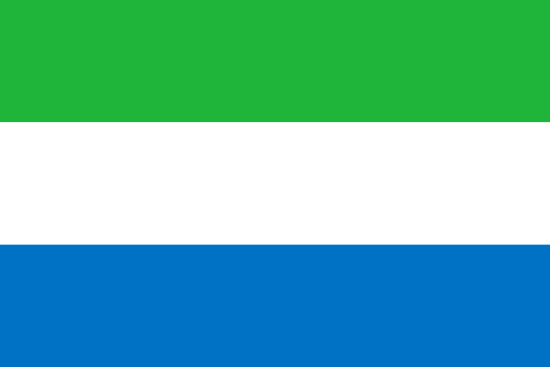
Sierra Leone

  • President:Julius Maada Bio
  • Vice President:Mohamed Juldeh Jalloh
  • Capital city:Freetown
  • Languages:English (official, regular use limited to literate minority), Mende (principal vernacular in the south), Temne (principal vernacular in the north), Krio (English-based Creole, spoken by the descendants of freed Jamaican slaves who were settled in the Freetown area, a lingua franca and a first language for 10% of the population but understood by 95%)
  • Government:No data
  • National statistics office
  • Population, persons:7,557,212 (2017)
  • Area, sq km:72,180 (2017)
  • GDP per capita, US$:499 (2017)
  • GDP, billion current US$:3.8 (2017)
  • GINI index:34 (2011)
  • Ease of Doing Business rank:160 (2017)
All datasets: F G N
  • F
    • July 2015
      Source: African Development Bank Group
      Uploaded by: Knoema
      Accessed On: 06 August, 2015
      Select Dataset
      The AfDB Statistics Department and the Fragile States Unit have compiled this data set from various sources (the World Bank, WHO, IMF, and many others)
  • G
    • July 2016
      Source: World Economic Forum
      Uploaded by: Knoema
      Accessed On: 13 January, 2017
      Select Dataset
      Data cited at: The World Economic Forum https://www.weforum.org/ Topic: The Global Information Technology Report 2016 Publication URL: https://www.weforum.org/reports/the-global-information-technology-report-2016 License: https://creativecommons.org/licenses/by-nc-nd/4.0/legalcode   This Dataset contains proprietary and non-proprietary data used in the computation of the World Economic's Forum Networked Readiness Index. By making this data available, the Forum aims to inform multi-stakeholder dialogue, foster evidence-based, data-driven decisions, allow measuring progress, and support research by academia, journalists and others.
  • N
    • March 2016
      Source: African Development Bank Group
      Uploaded by: Knoema
      Accessed On: 24 October, 2016
      Select Dataset
      3The Africa Infrastructure Country Diagnostic (AICD) was an unprecedented knowledge program on Africa’s infrastructure that grew out of the pledge by the G8 Summit of 2005 at Gleneagles to substantially increase ODA assistance to Africa, particularly to the infrastructure sector, and the subsequent formation of the Infrastructure Consortium for Africa (ICA). The AICD study was founded on the recognition that sub-Saharan Africa (SSA) suffers from a very weak infrastructural base, and that this is a key factor in the SSA region failing to realize its full potential for economic growth, international trade, and poverty reduction. The study broke new ground, with primary data collection efforts covering network service infrastructures (ICT, power, water & sanitation, road transport, rail transport, sea transport, and air transport) from 2001 to 2006 in 24 selected African countries. Between them, these countries account for 85 percent of the sub-Saharan Africa population, GDP, and infrastructure inflows. The countries included in the initial study were: Benin, Burkina Faso, Cameroon, Cape Verde, Chad, Côte d’Ivoire, Democratic Republic of Congo, Ethiopia, Ghana, Kenya, Lesotho, Madagascar, Malawi, Mozambique, Namibia, Niger, Nigeria, Rwanda, South Africa, Senegal, Sudan, Tanzania, Uganda, and Zambia. The study also represents an unprecedented effort to collect detailed economic and technical data on African infrastructure in relation to the fiscal costs of each of the sectors, future sector investment needs, and sector performance indicators. As a result, it has been possible for the first time to portray the magnitude of the continent’s infrastructure challenges and to provide detailed and substantiated estimates on spending needs, funding gaps, and the potential efficiency dividends to be derived from policy reforms.

Our Privacy Statement & Cookie Policy

Our website uses cookies to improve your online experience. They were placed on your computer when you launched this website. You can change your personal cookie settings through your internet browser settings.

Privacy Policy